Wednesday, March 7, 2018

Fruits and Flora

So, just in case you've had quite enough birds for now, thank you, I thought I would go with some fruited winter flora.


The elongated hanging cones on the big spruce trees in the park remind me of holiday ornaments, especially with the garlands of grape vines and the flocking of snow.  The squirrels are beginning to tear these apart with abandon. I see lots of the little, individual seed covers strewn all over the ground beneath these trees, along with the empty cores. 


I thought the red sumac drupes were quite dramatic against the gray and white background. .


Like the sumac, Michigan holly has brilliant red fruit that also stays on the plant long after the leaves have fallen. It is a great food source for robins, mockingbirds, bluebirds and cedar waxwings, all of which are beginning to work their way back north again.

See? I just had to get the birds in there somehow, didn't I?

Tuesday, March 6, 2018

Goldies

Since I've been having fun with the bird character studies, I thought I'd try another one. 


I always enjoy the muted winter plumage of the goldfinch. I know it isn't as stunning as the bright summer yellow phase, but there's something soft and pleasant about it.


The females keep the understated golden-olive color all year, but before long, the male goldfinches will start to molt and become motley little harlequins of olive, black and brilliant yellow.


I'll try to get some new pictures when the garish intermediate phase takes hold. It can be a pretty comical show.


In the meantime, I'll just enjoy the busy, chattering flocks that entertain me with their antics.


I expect a goldfinch carving or two will get added to the list of possible projects, but I may wait for full courtship dress before I think too seriously about it. 

I absolutely love that I got lucky and caught the incoming finch in this last photo - complete with landing gear down...

Monday, March 5, 2018

Ornamentation

My eye was caught by two bright splashes of magenta against the dark needles of a spruce tree on an otherwise pretty gray day.


Upon closer inspection, I identified two male house finches using the tree as a handy windbreak.


I used the zoom feature of the camera to try and get a closer look without scaring them away. While the picture isn't entirely clear, it's still good enough to observe the striped markings and rosy head and breast feathers.

Don't they look like Christmas ornaments in the snowy spruce? 


Sunday, March 4, 2018

One of Those Really Long Material Testing Posts

Yep, this is going to be a long one. I'm going to go through all the questions I asked on the test prompt form and give a summary of tester responses. If you don't have the patience for the whole thing, you can at least enjoy some really awesome carves.  

I have actually gotten responses from five of the seven testers, but I only have the actual prints in my possession for four so far, so this will cover the ones I have in my hot little webbed feet and the other three reports will come in a later installment. I just couldn't stand it any longer and had to share some of the findings.

What, if anything, did you do to prep the block before transferring your image? 

Two sanded, two acetone wipes. The two acetone testers swiped one side of the block and left the other unprepared. Both thought the prepared side inked and printed better than the unprepared side. 

What type of transfer method did you use? 

Acetone/toner-laser printer, inkjet/label paper, parchment/printer type not known, parchment/inkjet.


Did it take a transfer well?
Is the transfer clear and high contrast, showing detail well?
Does the transfer stay on the material without smearing or sliding?


All methods seemed to transfer well, without smearing or sliding. Contrast was a bit of a problem for some testers, but that was due to the color of the block - I thought it was on the dark side, too, so the final material will be lighter in color.


Thanks to dancing pecan for awesome work on the tiniest of  the samples - just a cut-off from my trial piece! She used x-acto knives and a dissecting knife on the itty bitty eye dot detail.  I had to rotate this image so that I could post it at the same size as the ones with portrait orientation - it didn't fit otherwise. 


What tool(s) did you use?
Staedtler #1v, Staedtler #1v reversed, Speedball #1 modified, Speedball #2 reversed, Speedball #5, Japanese gouge, craft knife, x-acto knife (both sharp and dull), dissecting pin.

Using properly sharpened tools, does the cut path have clean edges?
Is the consistency of the block smooth or grainy? 


Three of the four found edges clean, one thought the Japanese cutter worked better than the Staedtler, which she thought was work to push through the material. Three of the four thought the material was smooth, one didn't answer that question. 

Does the gouge or knife slip during shallow cuts or when ending cuts?
Does the material release easily from the block as you finish each cut?
How would you rate the level of pressure it takes to move the tool through the material?


Slipping didn't seem to be a problem for anyone and three of the four found that the material released easily from the block as a cut was finished. One had trouble with material release at the end of cuts - she found that the knife worked better than a gouge for her and the gouge wanted to escape for her as she pushed harder on the material. 


Thanks to Baqash, who used a Japanese gouge, craft knife and Staedtler gouge to carve this darling image of Pepe. She found the material challenging, but sharper tools helped. I think the thinness of the material sample may have played a part in some of the trouble, but we'll have to wait until I have a thicker sample to test that theory. 


How would you rate the level of pressure it takes to move the tool through the material? 

One carver gave a rating of 7 out of 10, with pink being 1 and OZ being 10. One said easier to cut than OZ and firmer than SQL. One tester also holds the block in the hand and said the thin sample caused some contortion, which caused the need for more pressure than a thicker piece might need. One thought it was easy and didn't take much pressure. One thought it was hard to carve. 

Rate the ability to make fine, straight lines? 

Three said very good to excellent, one had trouble with fine lines. One had trouble with clean-up, others didn't seem to. 


Thank you, Linden Leaf, who did a great text carving on another tiny cut-off piece from my daffodil test. She used Staedtler #1 modified and unmodified gouges, along with a Speedball #5. She left the outside frame around the text, so it gives a good idea about the quality of inking on larger, positive areas. 


Can you imagine this block at about .25 inches thick? If so, do you think it would be firm enough to hold fine details, or squishy such that stray background marks would show if the stamp were not mounted? 

All four thought it would be firm enough so that it would not cause stray background marks and would hold fine details. One didn't know if it would need to be mounted or not.

Did you try tools with different levels of sharpness and did it make a difference if you did? 

For those who tried both, it seemed that, for the most part, sharper tools worked better, but didn't make a huge difference or didn't make a difference at all. 

What kinds of ink(s) did you try? 

A huge variety of inks were tried.

Did the carving hold the ink smoothly and evenly? 

Yes, on details. 


Thank you to Foraych, who also carved some seriously tiny detail on this Kennedy half dollar and did a thorough test of inks as well. He used a Staedtler #1v reversed for detail and a reversed Speedball #2 for clean-up. I had to rotate this image so that I could post it at the same size as the ones with portrait orientation - it didn't fit otherwise. 


Do large positive spaces hold and transfer ink well. 


This depended a little on the ink, with some working better than others. For the most part, this ranked pretty well, with one carver saying she'd like better coverage, but it wasn't necessary - so good enough. I tried to show a representative cross section of the inks and quality of prints, but didn't scan every single one, since there were lots of different inks tested.

Other comments:

There was a range of these, but three of the four thought it was easier to cut and less elastic than OZ Kut. I even had one compare it to Orange PZ - that sort of made my day, since PZ is the Holy Grail and what I'm trying to replicate! One said it was sort of a blend of the the texture and firmness of OZ with the the texture of PZ Kut. One said she'd stick with OZ over this new material.

There were other comments, but I'll let the testers chime in with other observations either here in the comments or on the AQ boards, so this post doesn't get even longer. 

Once again, thank you to these four fantastic testers. I really appreciate the honest feedback about things that worked well and things that didn't for a range of carving styles. It really helps me think about what next steps might be necessary to get to a material we can love as much as we loved PZ Kut!  And I might even let you know what I think of the stuff when I post the other three tester results - I didn't want to say anything and possibly taint test results until others had gotten a chance to try it and report back. :)


Saturday, March 3, 2018

Nutty - and a Bit Buggy?

Allow me to introduce you to another of my favorite unassuming but awesome little birds.


The white-breasted nuthatch is a lovely addition to the backyard bird population.


While these birds enjoy nuts of all kinds - peanuts and peanut butter, sunflower hearts, as well as suet in my yard during the winter months, they also do a lot of good work ridding the world of unpleasant buggy things. 


They are usually found clinging to the sides of trees (often upside down) poking around in the bark crevices looking for tasty insects.


Some of the bugs they help keep in check include icky things like weevil and  wood-boring beetle larvae, as well as other kinds of beetles, sap sucking tree hoppers and scale insects, ants, gall fly larvae, caterpillars (including gypsy moths and tent caterpillars, both of which are very hard on trees), stinkbugs, and click beetles.


I have to think that the trees really appreciate their efforts - all those borers, sap suckers and leaf-eaters have to itch something awful! (I know, vivid imagination...)


Besides, who could possibly resist that pert little face? Not I!

So, don't be too surprised if I end up turning this photographic character study into a carving or two in the near future. 

Friday, March 2, 2018

In Flight Moves

Every now and then, I have the good fortune to catch a creature in motion and it always delights me.


Here is a sparrow getting ready to land beside another of the flock, while the mourning dove looks on from the other side of the feeder.


One female cardinal displaces another in this dramatic (and lucky!) shot.


Finally, a male cardinal looks more fish than fowl with his wings folded up and his tail fanned out to slow him for landing. The fish comparison does hold up - it looks like he's giving me a little bit of an accusing fish-eye glare as if to warn me away from the buffet table.

Thursday, March 1, 2018

A Bird in the Hand

Remember the other day when I was nattering on about the curiosity and boldness of the chickadee? 


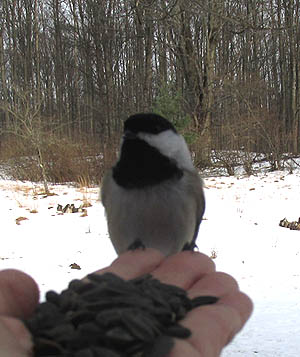
When I was a child, we used to entice them to land on our hands for the reward of a big, fat peanut half.


My brother revived the practice of hand feeding last year before putting out sunflower seeds for the hungry little rascals and they quickly decided to swoop in and get a snack. Once the big pile of seeds is spread, they aren't quite as desperate for a handheld handout.


As a result of his patience, I got to enjoy an old childhood pastime. 

It's really quite delightful to hear them fluttering around my ears and then feel their tiny toes gripping my fingertips as they look me over before choosing a seed and flying away. Sometimes, one will take the time to try and jam two seeds into its beak - it's pretty comical.